




Agotado
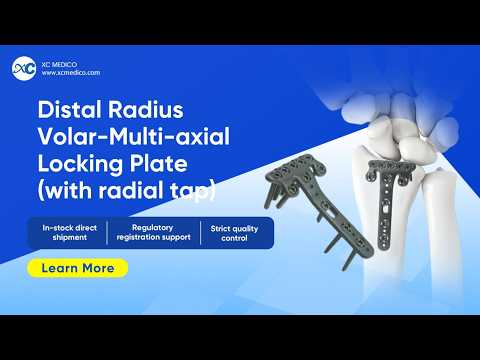
Distal Radius Volar-Multi-axial Locking Plate(withradial tap)
Distal Radius Volar-Multi-axial Locking Plate(withradial tap)
Precio habitual
$69.00 USD
Precio de venta
$69.00 USD
Precio habitual
Envío calculado al finalizar la compra.
Agotado
Have questions about this product?
Leave your WhatsApp contact information, and one of our 17 dedicated sales managers will provide you with a detailed response within 24 hours.
No se pudo cargar la disponibilidad de recogida
Distal Radius Volar-Multi-axial Locking Plate (with radial tap)
Sterilized (Ethylene Oxide) ISO 13485 Certified CNAS Laboratory Accreditation
An advanced, anatomically contoured locking plate system engineered for the comprehensive management of distal radius fractures. Featuring a ±15° universal multi-axial hole design and a low-profile footprint, this system delivers omnidirectional stress distribution and triple-column support, particularly excelling in complex osteoporotic cases.
✨ Core Clinical Advantages & Design
- Omnidirectional Stress Distribution: Multi-directional stress distribution is specifically designed for osteoporosis, significantly improving trabecular bone grip and construct stability.
- All-Around Support: Delivers robust triple-column all-around support utilizing an angle-stabilizing inner frame structure.
- Flexible Fixation Mode: Hybrid fixation compatible, allowing surgeons to flexibly switch between locking and cortical fixation modes to best suit the fracture pattern.
- ±15° Universal Hole Design: Advanced multi-axial locking technology enables screw angulation of up to 15 degrees in any direction, accommodating variable fracture fragments.
- Anatomical & Low-Profile Fit: Conforms precisely to the proximal radius anatomy. The low-profile safety design minimizes soft tissue irritation and dramatically reduces the risk of tendon injury.
- Premium Craftsmanship: Manufactured from TC20 Titanium alloy conforming to GB/T 13810-2017. Processed via sub-micron CNC turning, milling, and wire EDM, with fine polishing, grinding, and oxidation for a ≥98.9% quality rate.
🔬 Clinical Indications
| Primary Fracture Fixation | Complex & Revision Cases |
|---|---|
| Distal radius fractures (AO/OTA types A, B, C) | Osteoporotic distal radius fractures |
| Intra-articular comminuted fractures | Malunion / nonunion of distal radius fractures |
| Fractures with dorsal / volar displacement | Post-traumatic wrist arthritis requiring reconstruction |
📦 Implant Specification List
Compatible Screws
| Screw Type | Specification | Model Lengths |
|---|---|---|
| Locking Screw (HA2.7) | 2.7mm | 8–44mm (2mm/gear) |
| Cortical Screw (HC2.7) | 2.7mm | 8–44mm (2mm/gear) |
Volar Distal Radius Plates
| Product Code | Specification | Compatible Screws |
|---|---|---|
| RPRYZCDRW2HL | 2 Holes - Left (2HL) | HA2.7 / HC2.7 |
| RPRYZCDRW2HR | 2 Holes - Right (2HR) | HA2.7 / HC2.7 |
| RPRYZCDRW3HL | 3 Holes - Left (3HL) | HA2.7 / HC2.7 |
| RPRYZCDRW3HR | 3 Holes - Right (3HR) | HA2.7 / HC2.7 |
| RPRYZCDRW4HL | 4 Holes - Left (4HL) | HA2.7 / HC2.7 |
| RPRYZCDRW4HR | 4 Holes - Right (4HR) | HA2.7 / HC2.7 |
| RPRYZCDRW5HL | 5 Holes - Left (5HL) | HA2.7 / HC2.7 |
| RPRYZCDRW5HR | 5 Holes - Right (5HR) | HA2.7 / HC2.7 |
| RPRYZCDRW6HL | 6 Holes - Left (6HL) | HA2.7 / HC2.7 |
| RPRYZCDRW6HR | 6 Holes - Right (6HR) | HA2.7 / HC2.7 |
| RPRYZCDRW7HL | 7 Holes - Left (7HL) | HA2.7 / HC2.7 |
| RPRYZCDRW7HR | 7 Holes - Right (7HR) | HA2.7 / HC2.7 |
| RPRYZCDRW9HL | 9 Holes - Left (9HL) | HA2.7 / HC2.7 |
| RPRYZCDRW9HR | 9 Holes - Right (9HR) | HA2.7 / HC2.7 |
📄 Surgical Approach & Supply Specifications
- Surgical Approach: Volar plates are typically placed via the modified Henry approach. Two standard volar approaches exist for distal radius fractures; select the appropriate trajectory based on the specific fracture geometry.
- Sterilization State: Implants are supplied pre-sterilized via Ethylene Oxide (EO). Do not use if the sterile packaging barrier is compromised or damaged.
- System Compatibility: Only use the designated 2.7mm multi-axial locking or cortical screws provided within this specific system to ensure proper thread engagement and locking strength.
⚠️ Clinical Precautions & Regulatory Disclaimer
- Multi-axial Locking Limit: When utilizing the universal hole design, do not exceed the maximum ±15° angulation limit. Exceeding this angle may result in cross-threading and failure of the locking mechanism.
- Soft Tissue Protection: Ensure the plate is seated as flush as possible to the volar cortex. While the low-profile design minimizes risk, protruding screw heads or malpositioned plates can still cause flexor tendon irritation or rupture over time.
- Intraoperative Imaging: Utilize continuous fluoroscopy to confirm adequate fracture reduction, correct plate placement (respecting the watershed line), and to verify that screws do not penetrate the radiocarpal or radioulnar joints.
Payment & Security
Métodos de pago
Your payment information is processed securely. We do not store credit card details nor have access to your credit card information.


